The Nature of My Backyard

I love wild birds, flowers, herbs, trees, butterflies, bugs and anything else Mother Nature places in my backyard for me to enjoy! I gladly share them with you.
Showing posts with label wild birds. Show all posts

Thursday, March 12, 2015

Fabulous Male Birds! Masters of Fashion, Song & Dance!

Discover the reasons male birds are so gorgeous!
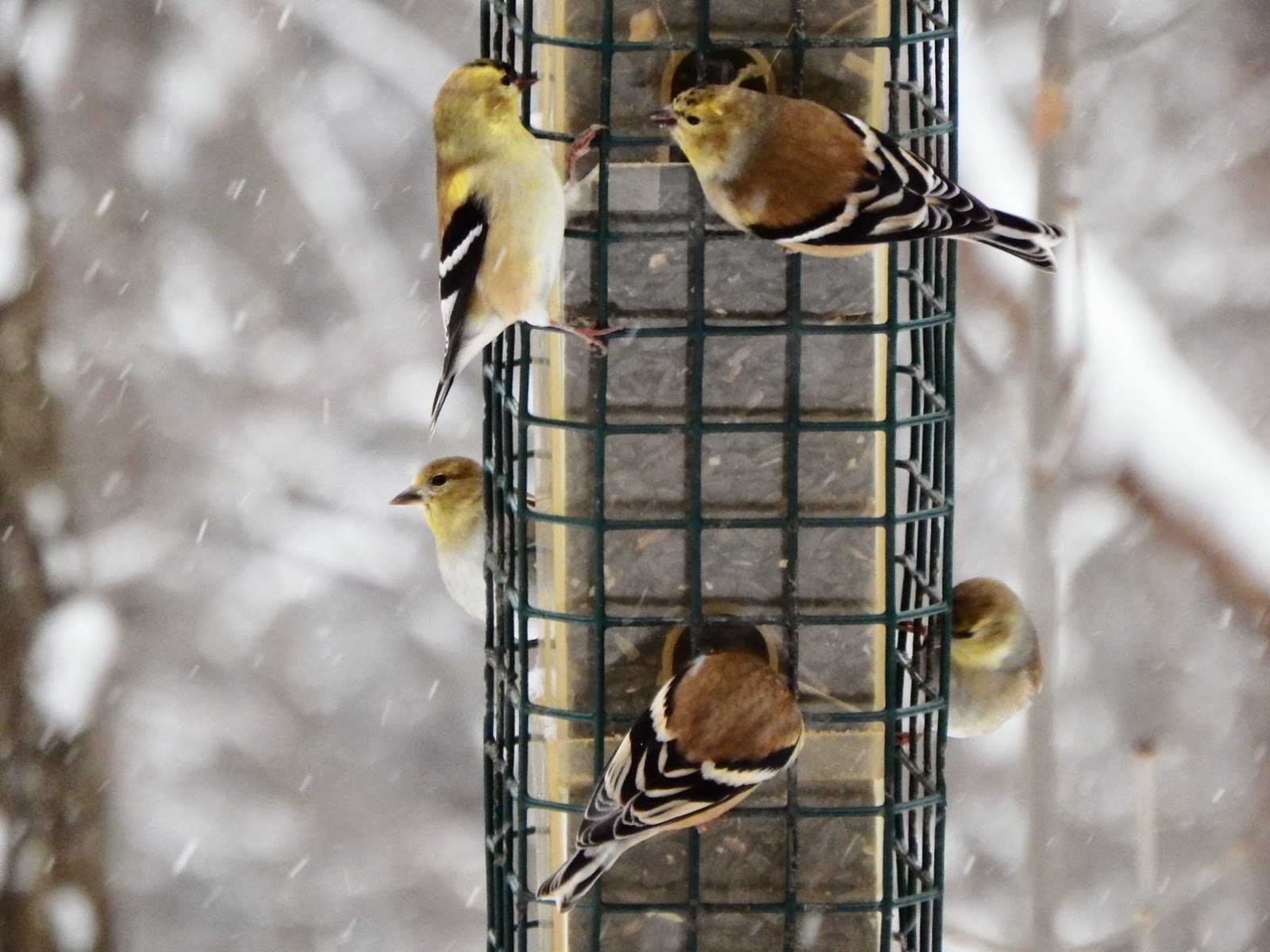
How pretty are these goldfinches, especially the males!

Wild Bird Fun for Everyone!


Cornell Lab of Ornithology unravels the mystery with a fun, informative, interactive series of videos and quizzes designed to answer the age old question of why male wild birds are the most fashionable and fabulous!

The Mystery of Beautiful Males—Explained

We love birds because of their outrageous beauty—but why is it the males that so often look fabulous? It's an age-old question, now explored in depth at All About Bird Biology. With colorful quizzes and rare footage, you’ll get to know males that use feathers, songs, dance moves, and even design skills to woo mates. Discover the upper limits of extravagance—and the reasons for it—with All About Fancy Males

Enjoy!
Grandma Pearl

Drama at the bird feeder!

Ever wonder why some birds fly away when others approach?  It's not just about the amount of room at the feeders, it's about the 'who's who' and their rank within the bird feeder territory!

Here's a short video from All About Birds that illustrates this hierarchy.  Click here 

Grandma Pearl

Friday, October 31, 2014

Weird Names of Groups of Birds!

Names of Groups of Birds from Old English, Latin and Greek originating more than 500 years ago

Ever heard of any of these?  I knew about the murmuration of starlings and the brood of hens, bevy of quail, but the rest were new to me!


bevy of quail
colony of penguins
covey of partridge
gaggle of geese
murmuration of starlings
murder of crows
parliament of owls
rafter of turkeys
bouquet of pheasants
brood of hens
cast of hawks
charm of finches
wedge of geese
sord of mallards
peep of chickens
ostentation of peacocks
kettle of hawks
party of jays
descent of woodpeckers
host of sparrows
dole of doves
paddling of ducks (on the water)

exaltation of larks


short video showing a 'kettle of hawks'


Wednesday, February 26, 2014

Tufted Titmice

Sweet Little Titmouse Looking Right At Me!
by Grandma Pearl

Tufted Titmice are feisty, territorial, energetic little birds that love to squawk at the top of their lungs when they perceive a possible threat.  At only 6.25 inches, their gray bodies sport a beautiful light orange patch on their underbellies.  Their crests belie their disposition, but are most often pointed straight upwards.
Titmice are very fond of peanuts and peanut butter!
from Grandma Pearl
Small apple chunks, raisins, and grapes are also favorite foods of the tufted titmouse.  If you have a grape arbor, you will attract not only titmice, but many other fruit-loving birds like orioles and grosbeaks.
Tufted Titmouse overseeing its territory from an Aspen tree
from Grandma Pearl
Listen for its distinctive call, which sounds like:  peter, peter, peter, or cheer, cheer, cheer.  It's a clear whistle that resounds through the forest around here, year 'round.  Titmice have pals, and they consist of chickadees, nuthatches, woodpeckers, and juncos that share the black oil sunflower feeders.  They also don't mind foraging along the ground for fallen seeds.

Titmice look for spiders and insects on and under the bark of trees, leaves and twigs, and they will even hang upside down to pluck a tasty treat!

Last spring I heard some skittery scratching noises against one of my back windows.  When I investigated, I found a tufted titmouse attacking its reflection repeatedly!  My solution was to cover the window with the top of a sapling that had lots of smaller branches.  This broke up the reflection, and my titmouse was spared an exhaustive defense against an imaginary rival.

Spotted in the northeast all the way to Texas, tufted titmice have several cousins:  Bridled Titmouse lives in the extreme southwest of North America, Oak Titmouse is found only west of the Sierra Nevada, and its call is a rather raucous sissi-chee.
Juniper Titmouse is a kin to the Plain Titmouse and lives in the western desert states of North America; Black-Crested Titmouse  can be found in Texas southward.  

All are small gray birds with crests.  The bridled titmouse was so named for the appearance of a black 'bridle' on its face and neck.
Most of these birds are fairly common, with the exception of the Juniper Titmouse, because of its very narrow southwestern habitat range.


Thursday, February 13, 2014

Flocks of Finches!

Finches Are Everywhere I Look!

American Gold Finches in their Winter Plumage
by Grandma Pearl

When it is finally spring, these friendly and chatty little finches will undergo quite a change.  The males will put on their brightest sunshine yellow coats and black hats.  Uttering a familiar call--'potato chip, potato chip', they will approach the feeders with an undulating flight pattern.  


Male and Female American Gold Finches in their spring/summer plumage.
by Grandma Pearl
The goldfinches here are accompanied by some mourning doves.  
 House Finches and Gold Finches love both sunflower seeds and thistle (nyjer) seeds
by Grandma Pearl

Pretty House Finches will brighten up once spring and summer roll around.  They happily share the feeders will the little goldies.


So many finches waiting their turns at the feeders!


American Gold Finches, males and females like to cling to vertical surfaces.  I love the intricate patterns of their wing feathers!


Thursday, January 30, 2014

How To Become A Citizen Scientist, No Matter What Your Age!

It Can Take As Little As 15 Minutes to Help Researchers, and It's Free!

Blue Jay at the Bird Feeder during a snow storm
by Grandma Pearl


It's Fun and It's Free

If you love to watch birds, no matter where you are, then you are well on your way to becoming a Citizen Scientist!  

The annual Great Backyard Bird Count (also known as GBBC) is coming!  Feb 14th through Feb 17th -- Mark your calendar.  The birds you count will be added to the worldwide data base.  Researchers and scientists will have unlimited access to all this invaluable information in their efforts to analyze bird populations and habitats.  

The data gathered helps them determine what is needed to help those birds whose habitats are shrinking, how healthy are bird populations overall, and what can be done internationally to insure our beautiful birds will survive and thrive.

No matter what your age, no matter where you live on the planet, you can participate.  School children, senior groups, individuals of all ages are welcome and encouraged to count birds.  This can be done from your own home bird feeders, a park you like to visit, schoolyard, workplace, etc.  It's so important for the birds!

You can spend just 15 minutes of one day during the 4-day period, or you can decide how much time and how many days you want to participate.  Go to ebird.org to signup and learn about the simple process of submitting your checklists online. Get ready to become an official Citizen Scientist!

GBBC Newsletter for news, tips and information about Citizen Science projects